

Dean Smith and Grace (my experience…)
Our regular contributor John Aldersley recalls his experiences machining on DSG machine tools and the introduction of a DSG lathe with CNC…. Here is John’s illustrated article:-
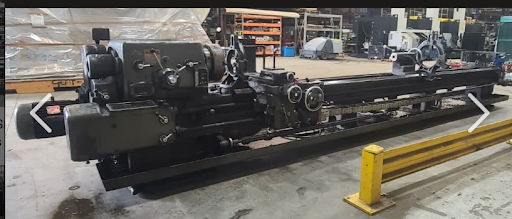
“I have just watched a You Tube video that was spirited to my phone today. Having watched it, and apart from a bit of artificial intelligence video input and I thought I saw a little milling in there, it looked good, whether it is correct or not. But what drew my attention was the mention of a retrofitted CNC. For a split second it took me back to a time at Wetherby Engineering when I was presented with one.
The video is below, see what you think ?
Before the said machine had arrived my DSG experience was the large centre lathe that Keith Burns worked on before I taught him to work on the Nakamura TMC4. Keith had come from Thomas Broadbent’s and was a fantastic turner.
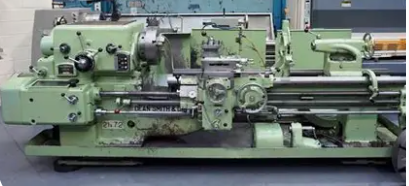
On a similar line to the one above probably having an 18 inch chuck, gap bed (no taper turning attachment) I had used it to skim faces up for some fixtures that I made, but not much else.
The other DSG was a special facing lathe that came from Broadbent’s, bought new from them with a feedable compound slide for machining a part called a discharge valve or coolie hat. The turners of note Peter Stoyles, Steve, aka Buffalo, Mr Pastry who kept doing whoopsies and Terry Bowater. You may wonder how I know that, well DSG have all the records of their lathes, using the serial number the parts department identified it, when I was after a lead screw, funnily enough I ordered one at £1200 (expensive at the time) it never arrived and we closed, so there we have it, or not.
 |
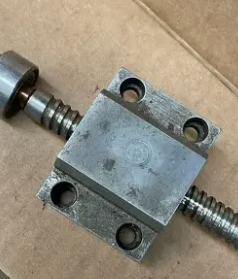 |
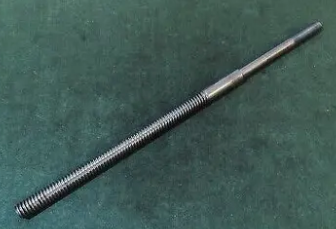
Our lead screw was knackered, that is one on the left, the part on the right is usually the sacrificial part was the nut, but ours was beyond repair, the lads had no chance of keeping silly tolerances the DRO couldn’t deal with it.
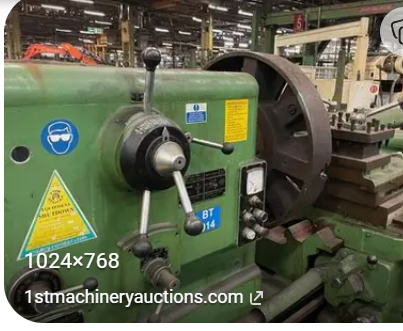
.
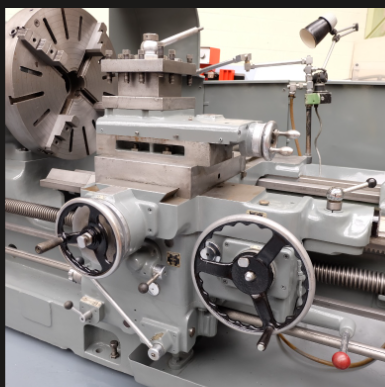 So this lathe arrives Clifford Wyatt. My MD kept buying machines and passing them to me to set up run, no training, manual or bugger all. I had gotten used to him doing it, but the lathe was a bit of a shock, it involved a cement foundation and a low loader and a bit of messing about to get into the works.
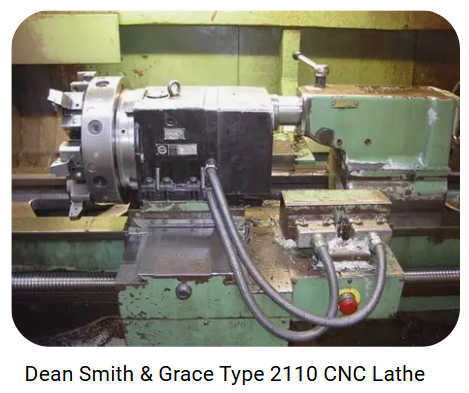 It was a retrofitted lathe by the look of it with a Bosch Alpha control, the likes I hadn’t seen before, but we did have a manual for it. The lathe was a large centre lathe (shaft lathe), complete with various chucks and steadies, not something I had any experience off. I can turn and did do a lot of turning with my H2 EITB module, but as my dad still calls me I am a button presser, my dad was a toolroom turner (20 years experience).Clifford had already decided it was going to be used to turn EN24T shafts for Broadbent’s, so we got the machine fired up and muddled our way through how it worked, the gearbox used hydraulic clutches, it was a bit of an open loop CNC which came and bit me on the bum a good few times, for instance if the turret hadn’t functioned correctly it would carry on trying to machine the large shaft.It was decided that we would turn the shafts between centres using a rather large carrier cut out of 50mm plate on our profile cutter, live centre in the headstock and a rotating centre in the tailstock.
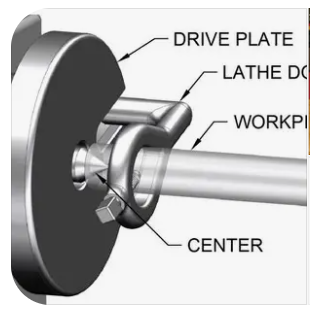 Bearing in mind the bar was 150mm or 6 inch and a few metres long it was a really interesting carry on, I programmed the machine using CAM and edited it to suit the control then set about turning it, to aid the issue of indexing I put a program stop into the programme to ensure the correct tool was in place.The gearbox was a noisy affair. The noise wasn’t for the faint hearted as it was a screech and because we had a fair bit of weight only held in the machine by Morse taper centres it was a bit hairy to say the least.
 Prior to starting cutting a customers shaft there was tooling to short out, At Wetherby we used negative tooling and because the shafts had undercuts in them as we were turning for grinding, leaving the 10 to 12 thou’ on (0.2 to 0.25mm) dia’ we choose to rough with CNMG 16 inserts with 1.2mm rad (cnmg160612) and to finish DNMG 150608 and threading with a ⅜ inscribed circle or ⅝ to cover the range of threading. So just 3 tool in the turret, balanced out to help the machine index.
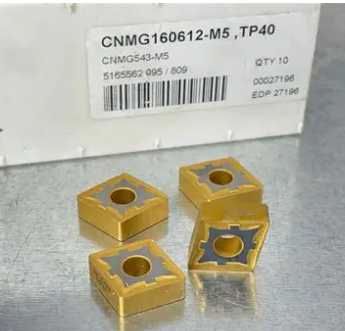 Roughing insert
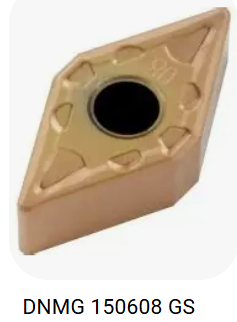 Finishing tool
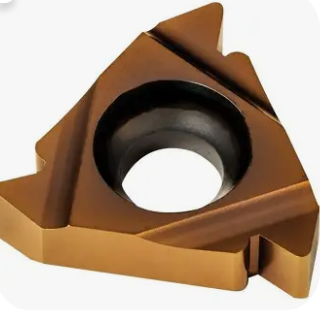 Threading insertSo I went looking for some bar to do some cutting trials on, then it was squeaky bum time as I took my first cut. I was very fortunate to be surrounded by some great engineers, they may not be keyed up on CNC, but turning they did, three of them John Bramhall, Bob Tempest and Rayman Mistry had all turned big stuff before while working at various places, so their help was asked for and freely given, I started with a 4mm a side cut (8mm on dia’) with a 0.3mm per rev feed, It went really well. I was lucky I selected a good speed ratio with enough torque. I eventually found that a 6mm cut worked well on the 1st op and 5mm on the second, smaller cut to 3mm if we had a fixed steady.A few pointers were learned greasing up the centres, how much pressure to apply at the tailstock, how tight to tighten the carrier, how to cut a thread to the correct size without being able to use the gauge, I topped the thread to 6 to 8 though under the major dia’. The machine did not have a synchronised spindle, so stopping the spindle midway through the G76 threading cycle was a non-starter.
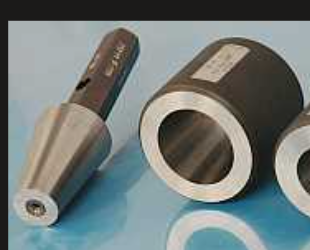
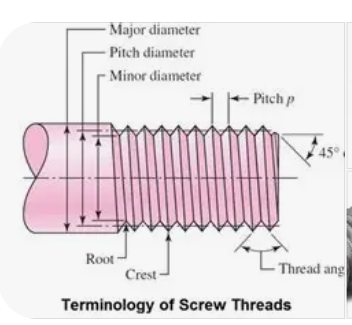 Something that I didn’t know much about was the taper on the front of the shaft, from memory it was 1 in 7 a standard, we had to leave again 10 to 12 thou’ on, and if lucky had a roughing taper gauge or if unlucky a finished gauge. Those of you who have used them will know that a very small cut can move the gauge a rather large amount so care when drawing the part (my job) was to ensure I added stock on for grinding, no stock for nominal dia’s.
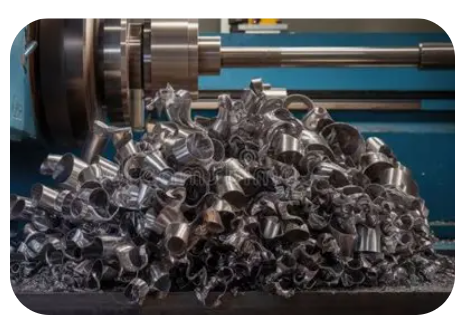
 Over the coming months the shaft production was improved, a problem with doing that is I was producing too much swarf. It was good swarf, but the metal removal rate was difficult to keep up to as the machine really wasn’t made for it. The coolant system couldn’t cope, and running out especially when screw cutting could be disastrous and no I didn’t do a risk assessment for the labourer to whizz in and shovel it out, steaming away.
 The only other issue was the running centre in the tailstock needed keeping an eye on. Once a job was proven out, one of the lads would run the machine, with the swarf, coolant setting up, gauges to keeping an eye on the cutting tool to ensure it wasn’t blunt. Keeping the an eye on the centre. Up to then had been no concern, till it stop spinning and welded to the shaft. Luckily I was there when it happened and managed to stop the machine, turning can be dangerous and a pair of overalls and safety specs wouldn’t save you.In conclusion, I wouldn’t buy used equipment, I bought the remaining clutches that DSG had but it wasn’t enough to keep the machine running, bearing in mind Wetherby Engineering included Broadbent drives and Noram Clutch. We made clutches but we couldn’t fix it. When I left Wetherby for a few years the machine was left unused, I had written an instruction manual, trained staff to use it, but I believe the work went elsewhere, we were subcontracted machinists.I returned a few years later as Works Manager, and got big Baz to come in and scrap the machine off. The machine was broken up in situ as other machines had been installed around it. As for DSG being good machines, yes they are, our retrofitted one had issues but gave me something to do, a nice pension, so thank you Mr Clifford Wyatt.”/
J. Aldersley – Past President & Council Member – Leeds Association of Engineers
.
.